
| (2026.07) Roles of Metal Vacancies in the Photocatalytic Hydrogen Peroxide Production by 2D ZnIn2S4 Nanosheets | |||||
| 작성자 | 관리자 | 작성일 | 2026-08-10 | 조회수 | 31 |
|---|---|---|---|---|---|
|
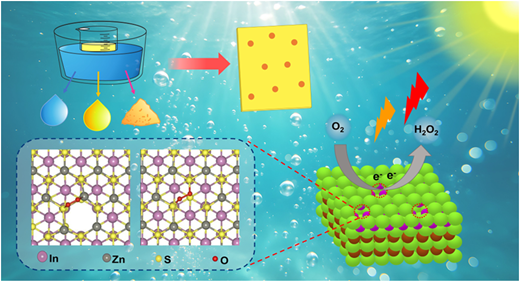
· 논문명 : Roles of Metal Vacancies in the Photocatalytic Hydrogen Peroxide Production by 2D ZnIn2-S4 Nanosheets · 저 자 : My-Ngan Tran, Tuyen Anh Luu, Duc-Viet Nguyen, Dang Nguyen An Nhien, Minh Chien Nguyen, Tiep Van Nguyen, Minh-Thuan Pham, Thuy Dieu Thi Ung, Do Danh Bich, Ngoc Linh Nguyen, Woo Jong Yu, Seung Hyun Hur, Nguyen Quang Hung*, Van-Han Dang*, Hoai-Thanh Vuong* · 게재지 : ACS Applied Nano Materials (2026, 9, 13667-13680) · 초록 Defects in two-dimensional (2D) ultrathin materials, driving the acceleration or deceleration of catalytic yields, can naturally occur during the material synthesis process. Therefore, gaining insights into this process is crucial and could play a pivotal role in catalytic studies and applications. Herein, we report the facile synthesis of defected zinc indium sulfide (ZnIn2S4) nanosheets via a heat-mediator strategy to produce hydrogen peroxide (H2O2) through photocatalysis. Our results show that heat mediators can be used to control the types of defects in the materials. Based on positron annihilation measurements, we confirm that the metal defects on ZnIn2S4 can be tuned by modifying heat mediators. These defective materials exhibit dynamic responses under different catalytic conditions, in which the activity of H2O2 generation can be adjusted. Based on our analysis, we demonstrate that the higher concentration of In defects would be beneficial for charge excitation, separation, and migration under light irradiation. In contrast, the higher Zn vacancies shift the valence location to significantly oxidative potentials, where direct water oxidation can occur to enhance catalytic performance, which would be hard to achieve on ZnIn2S4 with higher defects at In sites. Thus, these insights not only help the catalysis community establish structure–performance relationships but also offer a direction for synthesizing catalytic materials by simply tuning the heat mediator.
|
|||||