
| (2026.06) Confinement at Defect Sites Dissociates Ionic‐Liquid Pairs for Brain‐Like Organic Computing | |||||
| 작성자 | 관리자 | 작성일 | 2026-07-14 | 조회수 | 35 |
|---|---|---|---|---|---|
|
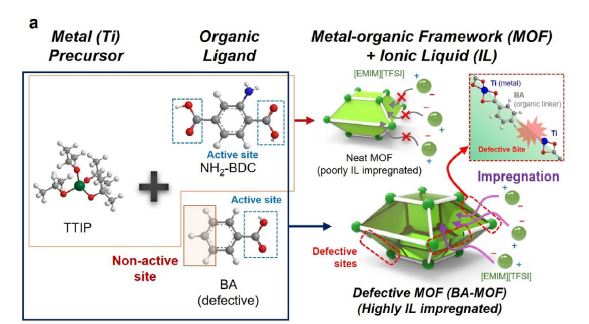
· 논문명 : Confinement at Defect Sites Dissociates Ionic‐Liquid Pairs for Brain‐Like Organic Computing · 저 자 : Chang Min Lee, Hye Jeong Son, Yongsang An, Jin Uk Kim, Hocheon Yoo, Seongbin Ga*, Chang Soo Lee*, Eun Kwang Lee* · 게재지 : Small (2026, 22, e73608) · 초록 Organic electrochemical transistors (OECTs) have attracted significant attention as devices for emulating brain-like information processing. However, their practical implementation is hindered by the limited ion modulation diversity at the active layer–electrolyte interface. To overcome this limitation, we introduce a metal–organic framework (MOF) as a selective ion-conducting layer to modulate ion-pair dissociation. The MOF layer is based on benzoic acid- modified MIL-125-NH2 (BA-MOF), which provides active sitesthat promote the efficient incorporation of ionic liquid ([EMIM][TFSI]) through intentional defect sites. The defective, highly porous architecture of BA-MOF possesses open-metal sites to tightly bound the ionic liquid. This integration suppresses ion diffusion through BA-MOF, enhancing mobility and overall OECT performance. The effectiveness of this strategy is further demonstrated by MNIST pattern recognition simulations, achieving a maximum accuracy of 94.72%, which is close to the ideal benchmark of 95.22%. This observation is supported by density functional theory (DFT) calculations, which revealed that the confinement of [EMIM][TFSI] ion pairs within BA-MOF reduces the ion-pair dissociation energy, thereby leading to an increased concentration of free anions. These findings highlight that defect-sites of MOF not only facilitate ionic-liquid dissociation but also enable and stable synaptic responses, providing a promising strategy for high-performance brain-inspired organic computing.
|
|||||