
| (2026.05) Interstitial boron-driven Pt surface strain for durable methylcyclohexane dehydrogenation | |||||
| 작성자 | 관리자 | 작성일 | 2026-06-16 | 조회수 | 44 |
|---|---|---|---|---|---|
|
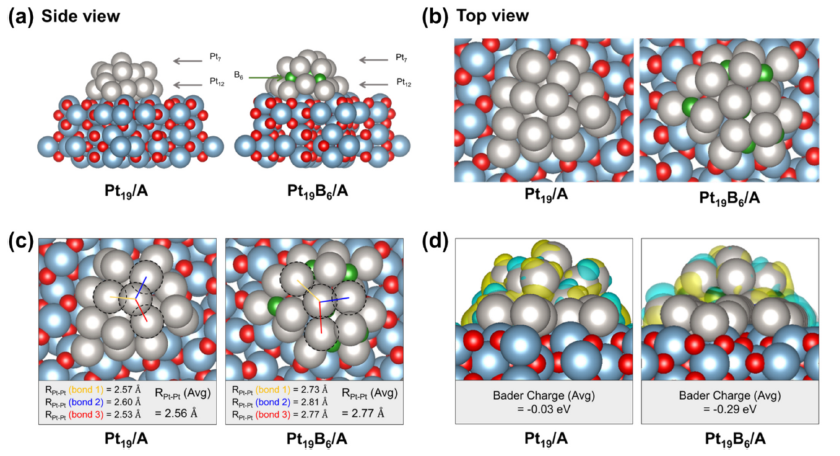
· 논문명 : Interstitial boron-driven Pt surface strain for durable methylcyclohexane dehydrogenation · 저 자 : ByeongJo Shim, K.C. Bhamu, Sojin Hong, Min Gyu Kim, Dongjun Kim, NaHyeon Hong, Jungwon Park, Sung Gu Kang*, Chang Won Yoon* · 게재지 : Applied Surface Science (2026, 729, 166234) · 초록 Methylcyclohexane (MCH) is a promising liquid organic H2 carrier for high-capacity, long-distance H2 storage and transportation, owing to its high compatibility with existing fossil fuel infrastructure. Although platinum (Pt) catalysts are widely used for MCH dehydrogenation owing to their excellent activity and selectivity, catalytic deactivation at temperatures above 300 ◦C remains a significant challenge that hinders commercial deployment. In this study, we present a simple impregnation strategy to generate interstitially B-incorporated Pt on alumina, PtB-X/A (X = 0.8, 3.2, and 7.5), where X denotes the B/Pt molar ratio. PtB-0.8/A catalyst exhibited superior stability during continuous MCH dehydrogenation at 300 ◦C under a liquid hourly space velocity of 3.6 mL g-c at 1h-1, producing high-purity H2 (>99.97 %) with a conversion of 95 % and a toluene selectivity of 99.99 %. Additionally, PtB-0.8/A demonstrated excellent stability over 200 h without noticeable deterioration. Experimental and theoretical studies revealed that doped boron atoms occupy interstitial sites, thereby elongating Pt–Pt bond length. Moreover, the amount of B doping was critical in determining catalytic performance. These findings highlight interstitial heteroatom doping as a promising alternative catalyst design strategy for enhancing the durability of MCH dehydrogenation, and suggest it as a feasibl e alternative to sulfur-based promoters.
|
|||||