
| (2026.02) Mild Hydrolysis of PET and Electrochemical Energy Recovery via Multifunctional Polyoxometalate Catalysts | |||||
| 작성자 | 관리자 | 작성일 | 2026-03-13 | 조회수 | 87 |
|---|---|---|---|---|---|
|
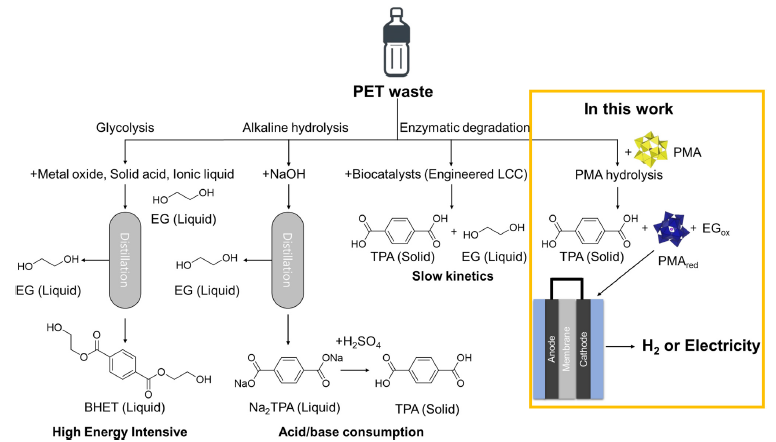
· 논문명 : Mild Hydrolysis of PET and Electrochemical Energy Recovery via Multifunctional Polyoxometalate Catalysts · 저 자 : Hyeonmyeong Oh, Ye Chan Lee, a Inhui Lee, Yuri Choi, Jiyeong Kim, Hyeongoo Kim, Kwang Min Kim, Yoonjeong Jo, Kwangjin An, Tae Hoon Oh*, Jungki Ryu* · 게재지 : Green Chemistry (2026, 8, 3573-3583) · 초록 Polyethylene terephthalate (PET) is a primary target for chemical plastic recycling due to its widespread use and relatively weak ester bonds in its structure. However, conventional PET depolymerization methods—such as alkaline hydrolysis, glycolysis, and methanolysis—are energy-intensive and require complex separation steps, which increase both costs and environmental impact. This study introduces a polyoxometalate-based recycling process to address these limitations. Under mild conditions (100 °C and low pressure in aqueous solution), polyoxometalates catalyze the depolymerization of PET via acid hydrolysis, producing high- purity terephthalic acid (TPA) and ethylene glycol (EG) as solid and liquid products, respectively. EG is further oxidized by polyo- xometalates to yield valuable compounds such as glycolic acid and formic acid, while simultaneously storing electrons. Under optimized conditions, EG oxidation achieves high selectivity (∼85%) toward formic acid. The stored electrons can be utilized for low-energy hydrogen production (125 mA cm−2 at 1.2 V) or electricity generation (12.5 mW cm−2 at 0.05 V). Crucially, our techno-economic analysis reveals that this approach, which combines revenue from high-purity TPA and valorized co-products, is cost-competitive and has the potential to supply TPA at a price lower than that of the virgin material. This work presents a technically robust and economically viable pathway toward a circular economy for plastic waste.
|
|||||