
| (2026.03) Engineering Pt3Ni and Pt3Co Catalysts for High-Performance Methylcyclohexane Dehydrogenation in Liquid Organic Hydrogen Carrier Systems | |||||
| 작성자 | 관리자 | 작성일 | 2026-03-13 | 조회수 | 100 |
|---|---|---|---|---|---|
|
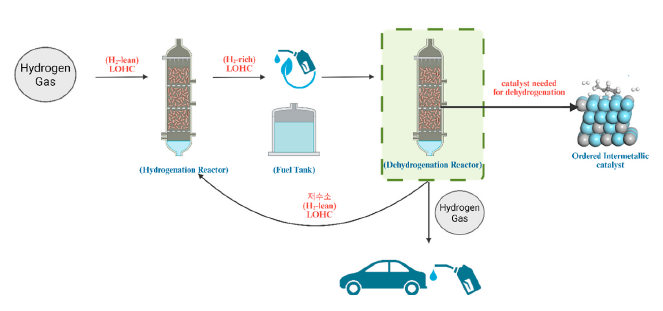
· 논문명 : Engineering Pt3Ni and Pt3Co Catalysts for High-Performance Methylcyclohexane Dehydrogenation in Liquid Organic Hydrogen Carrier Systems · 저 자 : Monica Malik, Jin Suk Chung*, Sung Gu Kang* · 게재지 : Materials Chemistry and Physics (2026, 352, 132013) · 초록 Liquid organic hydrogen carriers (LOHCs) serve as a powerful solution for efficient hydrogen storage, tackling essential challenges in advancing the hydrogen economy. Among LOHC systems, the methylcyclohexane/toluene pair has demonstrated industrial viability, yet the dehydrogenation process persists as energy-intensive and is significantly dependent on costly platinum-group metals. Density functional theory(DFT) computations were done to examine ordered intermetallic Pt3Ni(111), and Pt3Co(111) catalysts as alternatives to pure Pt(111), with dual aims of reducing the precious metal loading and enhancing catalytic efficacy. Through methodical mapping of the complete six-step MCH dehydrogenation network, we demonstrate that ordered Pt3Ni (111) consistently diminishes every C–H cleavage barrier relative to Pt(111) while reducing Pt content by 25 %. Furthermore, strategic surface modification with lithium promoter compresses the kinetic span to 0.37–0.83eV on Pt3Ni(111), significantly expediting the rate-determining steps. In contrast, the potassium promotion elevates the early-stage barriers (1.1eV) while rendering the final dehydrogenation step exergonic, illustrating orthogonal control over kinetics and thermodynamics. Biaxial strain engineering (±3 %) was investigated but demonstrated negligible synergistic effects. Crystal orbital Hamilton population (COHP) analysis elucidates that the superior performance of Pt3Ni (111) arises from optimal Pt–C and Pt–H bonding interactions, with lithium further modulating the electronic structure through charge redistribution. This research highlights essential design guidelines for future LOHC catalysts that balance performance, selectivity, and the utilization of precious metals, thus promoting the practical rollout of hydrogen transport technologies.
|
|||||