
| (2026.01) Oxygen vacancies promoted W–O–Mo interfacial bonding for stable CuWO4 photoanodes with accelerated charge transfer | |||||
| 작성자 | 관리자 | 작성일 | 2026-02-19 | 조회수 | 86 |
|---|---|---|---|---|---|
|
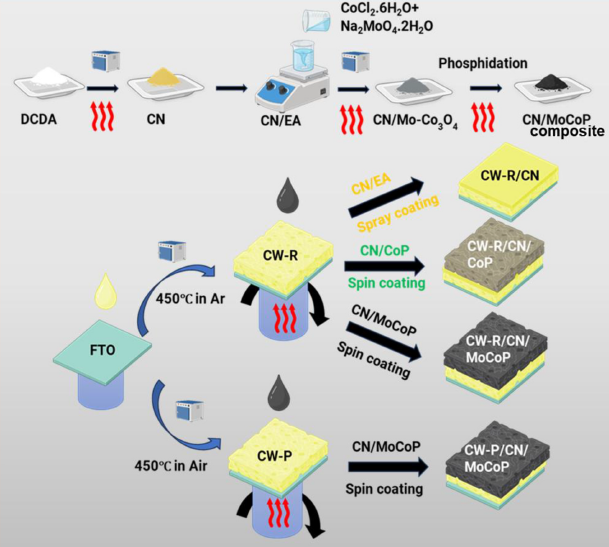
· 논문명 : Oxygen vacancies promoted W–O–Mo interfacial bonding for stable CuWO4 photoanodes with accelerated charge transfer · 저 자 : Nam Le1, Tam Van Tran1, Thanh Truong Dang, Jin Suk Chung, Won Mook Choi*, Seung Hyun Hur* · 게재지 : International Journal of Hydrogen Energy (2026, 204, 153307) · 초록 Since Pt cocatalysts play an important role in photocatalytic H2 evolution, it is necessary to track Pt over Pt/g-C3N4 catalysts Recently, CuWO4 has garnered significant attention as an oxygen-evolution photoanode for photoelectrochemical water splitting (PEC). However, the sluggish surface oxygen evolution reaction (OER) kinetics and the photocorrosion from tungsten ion leaching remain significant challenges. Herein, we construct an oxygen-vacancy-rich CuWO4 (CW-R) photoanode bridged to a Mo-doped CoP (MoCoP) cocatalyst with bulk g-C3N4 (CN) serving as a supported material in the CN/MoCoP composite. Oxygen vacancies on CuWO4 are expected to promote interfacial W–O–Mo “bridge” bonds that both chemically anchor the cocatalyst and create atomic-level charge transfer channels, which strengthen the interfacial contact quality between cocatalyst CuWO4 and lower the interfacial carrier-transport barrier. The CW-R/CN/MoCoP photoelectrode achieves outstanding PEC performance of 0.51 mA cm-2 at 1.23 V versus the reversible hydrogen electrode (RHE), which is 3 times higher than pristine CW-R. Chronoamperometry combined with ICP-OES confirms 4-folds reduction in tungsten leaching, while gas chromatography quantifies near-steady Faradaic efficiencies (~90 %). This study demonstrates the role of W–O–Mo interfacial chemical bonds, combined with a CN-supported material, as an effective interfacial design to simultaneously suppress photocorrosion and accelerate the charge extraction channel in CuWO4 photoanodes, thereby facilitating the construction of durable, high-efficiency PEC water splitting devices.
|
|||||