
| (2025.12) Catalytic Deactivation Behavior over Pt/g-C3N4 in Photocatalytic H2 Evolution via Changes in Catalytic Properties of Pt Cocatalyst and g-C3N4 Surface | |||||
| 작성자 | 관리자 | 작성일 | 2026-01-09 | 조회수 | 188 |
|---|---|---|---|---|---|
|
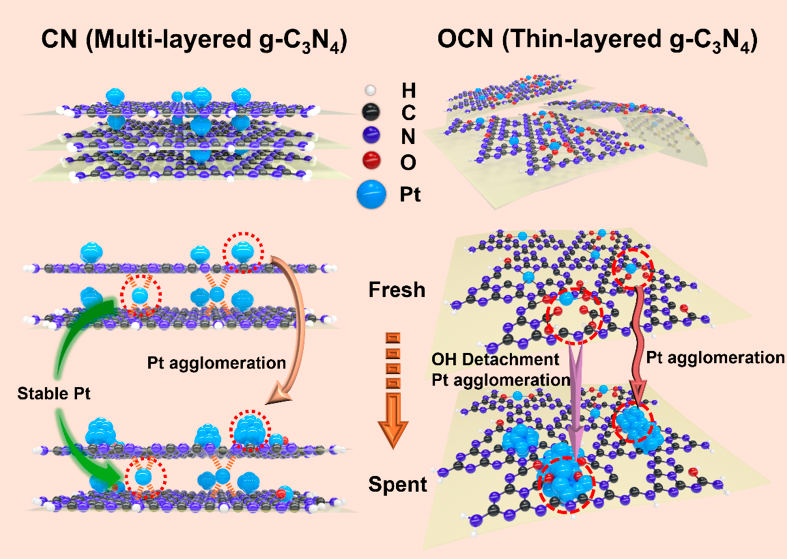
· 논문명 : Catalytic Deactivation Behavior over Pt/g-C3N4 in Photocatalytic H2 Evolution via Changes in Catalytic Properties of Pt Cocatalyst and g-C3N4 Surface · 저 자 : Chao Song, Phuong Anh Nguyen, Thanh-Truc Pham, Yong Men, Jin Suk Chung, Eun Woo Shin* · 게재지 : Catalysts (2026, 16, 29) · 초록 Since Pt cocatalysts play an important role in photocatalytic H2 evolution, it is necessary to track Pt over Pt/g-C3N4 catalysts during the evolution process to understand the associated photocatalytic deactivation behavior. In this study, bulk g-C3N4 (CN) and oxidized g-C3N4 (OCN) catalysts containing a Pt cocatalyst were prepared to investigate photocatalytic deactivation behavior through tracking changes in the catalytic properties of the Pt cocatalyst and g-C3N4 surface during photocatalytic H2 evolution. While CN catalysts show a lower photocatalytic activity than OCN catalysts, the former exhibit high resistance to catalytic deactivation with a lower deactivation rate than the latter. The high photocatalytic activity of OCN catalysts is caused by the highly dispersed Pt species on chemically oxidized g-C3N4 with abundant O-containing functional groups, relating to the excellent separation efficiency of photogenerated electron/hole pairs. During the evolution process, highly dispersed Pt species over fresh OCN are easily and rapidly agglomerated into large Pt nanoclusters due to its exfoliated thin-layered g-C3N4 structure, whereas the three-dimensional multi-layered g-C3N4 structure of CN catalysts hinders the agglomeration of Pt over the CN catalyst. In addition, during the photocatalytic H2 evolution, the O-containing functional groups on the OCN catalyst significantly disappear, which causes a weak metal/support interaction and, eventually, fast photocatalytic deactivation due to the agglomeration of Pt. Conventional studies on water electrolysis have primarily focused on designing novel electrocatalysts and membranes, with intrinsic properties closely linked to the immediate performance of water electrolyzers. However, less attention is directed toward porous transport layers (PTLs), which are essential for sustaining efficient, long-term, high-current operation by enabling effective mass transport. Here, a novel PTL with anisotropic wettability (AW-PTL) is introduced to enhance the efficiency of anion exchange membrane water electrolyzers (AEMWEs). By hydrophobically modifying the upper half of hydrophilic Ni foam with polytetrafluoroethylene using a simple spray-coating method, anisotropic wettability is achieved, enabling the directional transport of liquid electrolytes and gaseous products. This design significantly improves AEMWE efficiency by facilitating the removal of gas bubbles, which typically block catalyst active sites and hinder electrolyte supply. The method is universally applicable across conventional PTL types and demonstrates scalability to large-area (up to 225 cm2) and short-stack AEMWEs. This work advances the practical application of water electrolysis, providing an adaptable solution for other water electrolyzer types using existing catalysts and membranes. (AOFA-20) were obtained by calculating Fe-ZIF-8 functionalized by 3-amino-1,2,4-triazole in a crucible cup without a cap. The as-synthesized AOFA-20 demonstrated outstanding ORR activity (E1/2 = 0.828V vs. RHE), surpassing 20 % Pt/C (0.808 V) in 0.1 M KOH. It also exhibited superior long-term stability and methanol tolerance over commercial RuO2 and Pt/C. In practical zinc–air batteries, AOFA-20 achieved a narrowvoltage gap (1.19 V) and exceptional cycling stability (>560 hr), outperforming Pt/C– RuO2 (1.41 V, 65 hr). These findings highlight useful information for the development of AOFA-20 catalyst with abundant active sites for next-generation energy storage and conversion devices.
|
|||||