
| (2026.05) Enhanced CO adsorption via NO + NH3 reduction-assisted solid-state precipitation of CuCl in Y zeolite | |||||
| 작성자 | 관리자 | 작성일 | 2026-06-16 | 조회수 | 49 |
|---|---|---|---|---|---|
|
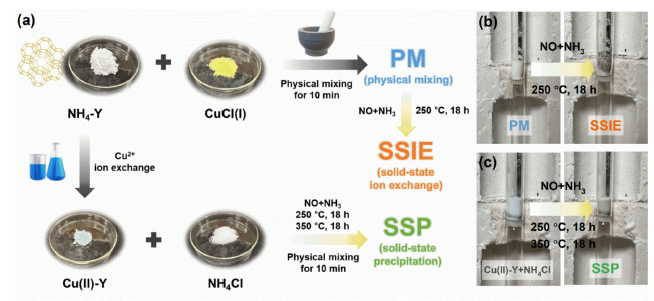
· 논문명 : Enhanced CO adsorption via NO + NH3 reduction-assisted solid-state precipitation of CuCl in Y zeolite · 저 자 : Hyunwook Kim, Hyun Min Chae, Jiwon Yim, Changhwan Yoo, Chan Hyun Lee*, Ki Bong Lee* · 게재지 : Chemical Engineering Journal (2026, 536, 176018) · 초록 Effective adsorptive separation is crucial for CO recovery. Conventional CO adsorbents have been synthesized by physically mixing CuCl, known for its strong CO affinity, with support materials like activated carbon, zeolites, alumina, and metal-organic frameworks, followed by thermal treatment. However, CuCl dispersion is often restricted to the support surface, and its effectiveness is not clearly understood. In this study, a novel solid-state precipitation method is proposed to enable the formation of highly dispersed CuCl nanoparticles within zeolite particles. This method employs the reduction half-cycle of ammonia-selective catalytic reduction to selectively reduce the ion-exchanged Cu2+ to Cu+ within the zeolite. The resulting adsorbent exhibits a CO uptake of 2.85 mmol g-1 (13.3 mmol g-1Cu, normalized to the total Cu loading) at 25 ◦C and 101.3 kPa, significantly outperforming samples synthesized via conventional methods. Moreover, the developed adsorbent exhibits excellent cyclic stability over repeated adsorption–desorption cycles. Isosteric heat of adsorption calculations, CO temperature-programmed desorption, and in situ infrared spectroscopy help to elucidate the role of highly dispersed CuCl, confirming its significant effect on the CO adsorption characteristics. This study successfully introduces a robust solid-state precipitation method for obtaining highly dispersed CuCl nanoparticles within the intraparticle regions of zeolite, which exhibits promising potential as an efficient CO adsorbent.
|
|||||