
| (2026.04) Direct air capture with solid sorbents: Adsorbent design, process engineering, and CO2 conversion | |||||
| 작성자 | 관리자 | 작성일 | 2026-04-29 | 조회수 | 79 |
|---|---|---|---|---|---|
|
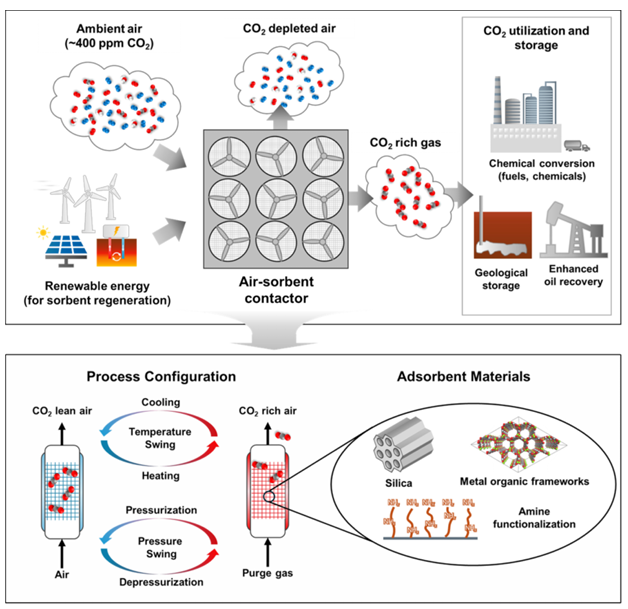
· 논문명 : Direct air capture with solid sorbents: Adsorbent design, process engineering, and CO2 conversion · 저 자 : Muhammad Hassan, Changdon Shin, Taekgi Lee, Seunghyun Lee , Somnath Chowdhury, Hyuk Taek Kwon, Sung Gu Kang*, Sol Ahn*, Yongchul G. Chung* · 게재지 : Chemical Engineering Journal (2026, 534, 175117) · 초록 Direct air capture (DAC) using solid sorbents is a promising negative-emissions technology, but its large-scale deployment remains constrained by coupled challenges in adsorbent performance, process efficiency, and technoeconomic viability. This review examines recent progress in solid-sorbent DAC through an integrated perspective that connects adsorbent design with process operation and system-level cost considerations. We summarize advances in physisorbent- and chemisorbent-based materials developed for ultradilute CO2 capture, with particular emphasis on amine-functionalized sorbents and porous frameworks evaluated under realistic humidity and temperature conditions. Key process configurations, including temperature swing adsorption (TSA), temperature–vacuum swing adsorption (TVSA), and steam- assisted variants, are critically compared in terms of regeneration kinetics, energy demand, and operational trade-offs. We further review recent technoeconomic analyses to identify dominant cost drivers, scale-up uncertainties, and design pathways for reducing energy consumption and capital intensity. Finally, emerging approaches for CO2 conversion using porous materials are discussed, with an emphasis on their compatibility with DAC-derived CO2 streams and their potential role in improving overall system economics.
|
|||||